
Warnings from the bond market and the end of easy money
In July, we warned that some pre-conditions for a bubble in sections of the US equity market were in place. In our research on bond-equity correlations, we argued that traditional views on portfolio diversification continue to be challenged in a moderate inflationary environment. Now, bond yields have surged again to levels not seen since 2007 and sections of equity markets continue their gravity-defying ascent. The cost of capital continues to move higher, exposing fragilities across financial markets. This creates both challenges and opportunities for investors seeking to build resilient portfolios.
The bond market has spoken
Global bond markets continue to signal caution ahead. Yields continue to rise at the long end of the curve with US 10-year Treasuries over 4.7% and the 30-year yield recently hitting 5.31%, the highest since 2007. In Australia, the 10-year yield has pushed through 5.04%, up over 70bps since October last year. These rising rates mark an inflection in a 40-year structural decline. In the US, yields have returned to levels last seen before the GFC; in Australia, to those of the commodity-driven boom that ran to 2011.
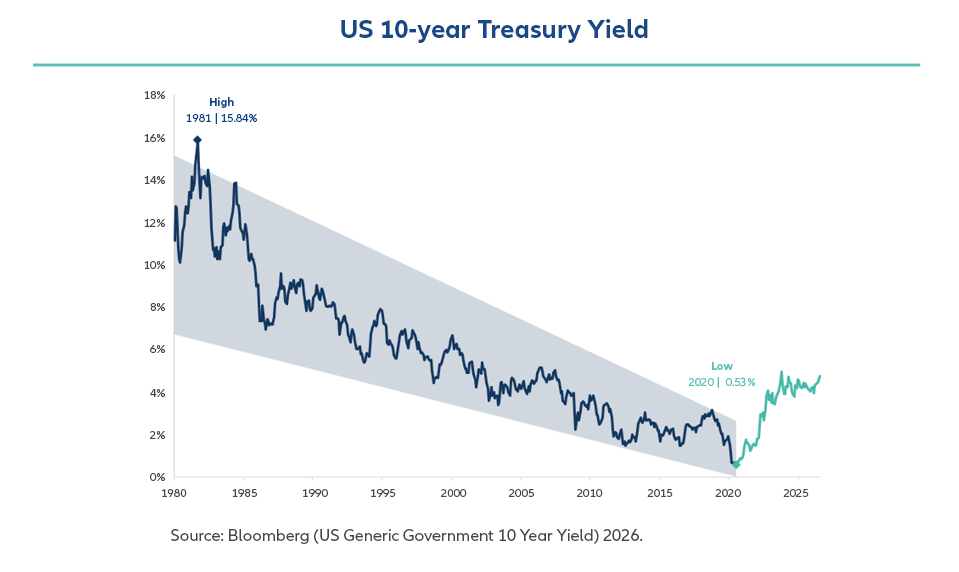
This dislocation of the bond market reflects a structural repricing of capital driven by forces we have previously identified. The transformative technology of AI is requiring the biggest infrastructure spend in the history of financial markets, increasingly funded by debt. This is competing for capital with the rapid ramp-up in defence spending, the energy transition and a geopolitical environment that is driving a costly transition of supply chains to focus on security over efficiency. The dynamic is further exacerbated by larger government spending manifesting in rising deficits and debt, with both countries reaching new milestones, the US annual deficit hitting $2T and Australian gross debt pushing past $1T in 2026. The outcome of which is simply that to achieve equilibrium, higher real rates are required.
Equities: does gravity matter?
Meanwhile, US equity markets appear disconnected from this. The S&P 500 returned approximately 15% and the NASDAQ 21% in the quarter ended June 2026 — the best quarterly performance in six years for both indices. The ten largest companies now account for ~40% of the S&P 500, up from ~26% in June 2020, a concentration in the very growth stocks most exposed to rising discount rates. SpaceX's IPO launched at a price-to-sales ratio of 90x, subsequently rising above 120x — a figure that makes Google's 2004 IPO at roughly 10x sales look quaint.
We identified two pre-conditions for a bubble: speculative behaviour and extreme valuations. Both remain unambiguously present. Investors continue to pay extraordinary premiums for future growth, seemingly slow to adjust to the mathematical reality that higher discount rates compress the present value of future earnings. History tells us that higher interest rates tend to precede inflections in equity markets by 12 to 24 months and the clock started ticking some time ago.
The diversification dilemma
Perhaps most concerning for Australian investors is what's happening beneath the surface of their portfolios. The historical negative correlation between bonds and equities — the very foundation of the 60/40 portfolio — has been less reliable during the 2020s. Recent risk-off events have seen simultaneous selloffs in bonds, equities, and even gold. When everything falls together, diversification becomes an illusion.
Furthermore, bond volatility has increased markedly, undermining their traditional role as stable defensive assets. Structural forces — deglobalisation, geopolitical ructions, rising government debt, shifting demographics, and persistent inflationary pressures — are reshaping market dynamics in ways that make traditional correlations unreliable. For portfolios that have been built on this historical relationship, the practical question is not whether to diversify, but what still works in the current environment.
What this means for investors
This decade has seen a reversal of prior trends with a moderate inflationary environment, higher rates and increased concentration of equity indices that challenges prevailing theories around portfolio construction. The 40-year tailwind of falling rates that supported both bond and equity returns simultaneously has structurally reversed and portfolios must be prepared for the potential implications of a new regime.
The path forward
For long term investors, particularly those in or approaching retirement, these risks are more acute. In a world where bonds may no longer reliably hedge equity risk, and equities are increasingly priced for perfection against a backdrop that historically precedes corrections, sequencing risk is elevated.
In such an environment, the relative certainty of portfolio income should be assessed in the context of rising credit and counterparty risk. Downside protection becomes paramount, and rather than simply diversifying across assets that increasingly share the same fragilities, investors should consider which assets can provide genuinely non-correlated income streams.
References
Allianz Retire+ Research, Interest rates up and equities to the moon (July 2026) – https://www.allianzretireplus.com.au/news-and-insights/insights/Bond_and_equity_markets_are_sending_conflicting_signals.html
Allianz Retire+ Research, Inflation slows but demand yet to budge (August 2026) - https://www.allianzretireplus.com.au/news-and-insights/insights/Inflation_slows_but_demand_yet_to_budge.html
This material is issued by Allianz Australia Life Insurance Limited, ABN 27 076 033 782, AFSL 296559 (Allianz Retire+). Allianz Retire+ is a registered business name of Allianz Australia Life Insurance Limited. This information is current as at August 2026 unless otherwise specified and is for general information purposes only. This information has been prepared specifically for authorised financial advisers in Australia and is not intended for retail investors. It does not take account of any person’s objectives, financial situation or needs. Before acting on anything contained in this material, you should consider the appropriateness of the information received, having regard to your objectives, financial situation and needs. No person should rely on the content of this material or act on the basis of anything stated in this material. Allianz Retire+ and its related entities, agents or employees do not accept any liability for any loss arising whether directly or indirectly from any use of this material.
We’re here to help.
Call or email us for assistance.
Any information on this website does not take into account your objectives, financial situation or needs. For personal financial advice please speak to your financial adviser. Products will be issued by Allianz Australia Life Insurance Limited, ABN 27 076 033 782, AFSL 296559.
Allianz Retire+ is the business name of Allianz Australia Life Insurance Limited. By using this website you agree to access this Financial Services Guide.
Allianz Retire+ is the business name of Allianz Australia Life Insurance Limited. By using this website you agree to access this Financial Services Guide.