Summary
- RBA talks tough
- Inflation risks materialise
- Cash rate at a 15-year high
Summary
Reality bites the RBA
In a unanimous vote, the Reserve Bank of Australia (RBA) has raised the cash rate to 4.60%, the fourth hike this year, and the highest level since 2011. Upside inflation risks have materialised to the point that even the ‘data-dependent’ Board didn’t need to wait for more formal CPI data before making a decision. Like many of its global peers, the RBA is trying to maintain credibility against a macro backdrop shaped by fiscal expansion, deglobalisation and ongoing military conflicts — a dynamic reflected in long-term sovereign yields bouncing around multi-decade highs.
Statement by the Monetary Policy Board
In the Board’s statement, the language around the Middle East conflict has hardened. In August, it described the impact as ‘so far, less than expected’. Now, just one meeting later, the conflict ‘has broadened’, energy prices are ‘much higher than assumed in the August forecasts’ and upside risks are no longer hypothetical — they are ‘materialising’.
That escalation in tone carries through the entire September statement, which is unmistakably more hawkish. The Board stressed that growth in aggregate demand must remain subdued for a sustained period to bring inflation back to target. While the three earlier rate rises were designed to achieve exactly that, the Board judged today that ‘a further tightening in financial conditions is warranted’ and explicitly called out ‘increasing the cash rate further if needed’.
Our Take
Australia now carries the second highest cash rate in the developed world, with a central bank that has abandoned any pretence of a pleasant ending to the current inflation challenge. The Iran conflict, once framed as a short-lived supply disruption, has defied the ‘temporary shock’ consensus. As an open, trade-dependent nation, Australia remains disproportionately exposed as nations continue to prioritise security over efficiency in the rerouting of global supply chains. The cumulative effect is an exacerbation of existing domestic structural drivers of inflation, with many of the RBA’s key risks having materialised.
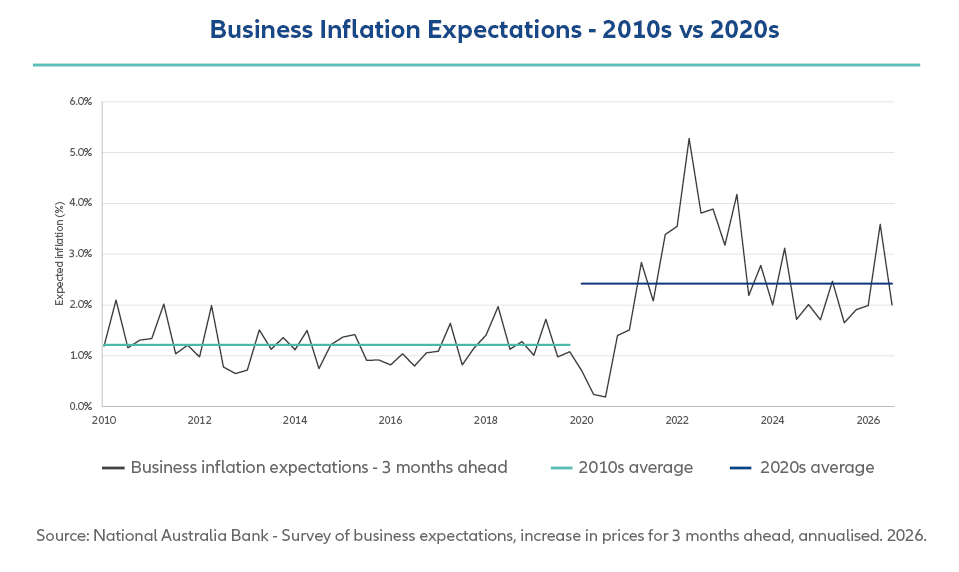
The normalisation of an elevated inflation environment creates a stubborn behavioural shift that can be difficult to reverse. During the recent Senate hearings, Governor Bullock acknowledged that the ‘fact that businesses are starting to ask the question, ‘Is inflation coming back down?’ is a bit of a concern to us’. History shows that inflation begets inflation and expectations, left unchecked, become self-reinforcing. Once embedded, businesses price forward-looking inflation into supplier contracts and service agreements, and employees negotiate wage settlements that reflect an acceptance of structurally higher costs of living. The resulting wage-price feedback loop is particularly potent in Australia due to relatively strong industrial relations settings.
On the current trajectory, it is likely a matter of time before mounting cost pressures collide with the real economy. Higher commodity prices may support nominal GDP in the short term, but mining profits and higher tax revenue will be of little consolation to small and medium businesses grappling with rising input, wage and borrowing costs. Markets are pricing in one to two further rate increases, however we see a material risk of a growth shock that curtails this hiking cycle earlier than expected.
Allianz Retire+ is a registered business name of Allianz Australia Life Insurance Limited ABN 27 076 033 782, AFSL 296559. This information contains opinions that are current as at September 2026 unless otherwise specified and is for general information purposes only and is not comprehensive or intended to give financial product advice. Any advice provided in this material does not take into account your objectives, financial situation or needs. No person should rely on the content of this material or act on the basis of anything stated in this material. Allianz Retire+ and its related entities, agents or employees do not accept any liability for any loss arising whether directly or indirectly from any use of this material.