Summary
- Cash rate reaches 18 year high
- Inflation still too high and broadening
- Recession risk rising as RBA downgrades growth outlook
Summary
Between a hike and a hard place
The Reserve Bank of Australia (RBA) today hiked for the fifth time in 9 months, lifting the cash rate to 4.85% in a majority (6-3) decision. The RBA is continuing to respond to the increased risk that expectations de-anchor and inflation becomes embedded in the Australian economy. There are indications that tighter policy is starting to bite in some areas with a slight weakening in the labour market and a decrease in housing credit. However, inflation still remains well above target at 3.6% (September trimmed mean) and overall credit remains strong as the continued boom in business investment offsets slowing housing conditions.
Statement by the Monetary Policy Board
Today’s decision was little surprise, as Governor Bullock provided a hawkish statement to parliament last week, pre-empting the release of the official CPI last Wednesday. The fact that they were willing to change their behaviour from ‘no forward guidance’ speaks to the escalating urgency of the situation as today’s statement added ‘broad-based’ to its inflation characterisation. Notably, the central bank also called out the increase in minimum award wages by the Fair Work Commission on July 1 as a driver of inflation across the local services sector. At a recent address, Deputy Governor Hauser acknowledged ‘... we are beginning to see some signs that some people in the community are not sure if we’re going to bring inflation back into target at all, or certainly not for an extended period’. Today’s statement reinforced these comments with several references to inflation expectations.
Our Take
Given Deputy Hauser has referenced a ‘central banker’s nightmare’ in recent public comments, the stagflationary era of the 1970s & 1980s is relevant to the boards latest decision. Although the Australian economy looks very different half a century on, the episode provides an instructive case of what happens when a ‘transitory’ supply shock mutates into persistent inflation. Combine that with parallels of fiscal stimulus running counter to monetary policy and severe productivity stagnation (though, notably, still above what we’ve seen in recent years), this latest hike reflects the RBA’s concern that history could rhyme with policy misstep requiring a more severe response further down the track.
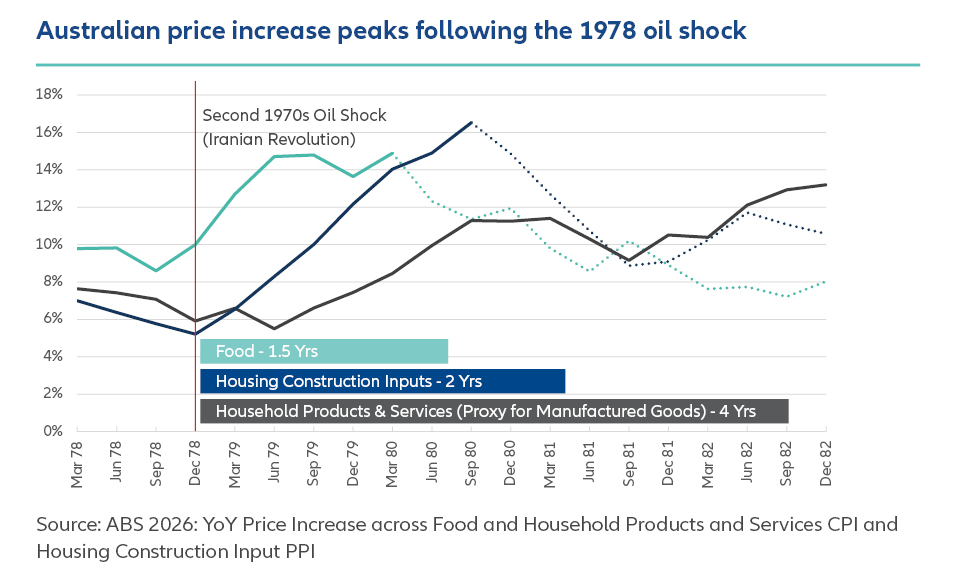
A crucial takeaway from this previous episode is that an energy shock is not experienced as a one-off spike to inflation (see graph below). The late 1970s showed that fuel price surges roll through successive layers of goods and services over a multi-year horizon before they are fully absorbed. This experience shows that impacts are likely to outlast any targeted response to the initial energy price hit. Consumers and businesses face the risk of sustained, broadening price increases until the shock has worked its way through the economy, and it is this drawn-out pass-through that poses the greatest risk for the board’s concern around inflation expectations.
The eventual crisis and its painful aftermath forced some important structural reforms: the dismantling of indexed wage increases, greater fiscal discipline, and deregulation of the financial sector.
Now, facing a still tight labour market and insufficient fiscal constraint, the RBA is hoping that their actions and institutional credibility alone can sufficiently dampen demand and price pressures. Monetary policy works with long and uncertain lags, and the 6–3 split reveals a board that is far from united on whether the job is done. Market participants will be keenly watching how this sharp increase in borrowing costs transmits to the modern Australian economy over summer.
Allianz Retire+ is a registered business name of Allianz Australia Life Insurance Limited ABN 27 076 033 782, AFSL 296559. This information contains opinions that are current as at November 2026 unless otherwise specified and is for general information purposes only and is not comprehensive or intended to give financial product advice. Any advice provided in this material does not take into account your objectives, financial situation or needs. No person should rely on the content of this material or act on the basis of anything stated in this material. Allianz Retire+ and its related entities, agents or employees do not accept any liability for any loss arising whether directly or indirectly from any use of this material.