Much of the focus in retirement planning is – understandably – on the income side of the ledger: how much is needed, and where does it come from. A resilient retirement income stream can help mitigate both longevity and market risks, and advisers can use many levers to build this resilience, including product selection and portfolio construction.


In this article, we examine the risks of a fixed spending approach, the evidence that supports the value of a dynamic spending strategy, and practical ways for advisers to help clients put a dynamic approach into practice.


Key points

  • Sustainable retirement planning requires reliable income with adaptable spending.
  • Essential expenses need dependable income; discretionary costs offer flexibility.
  • Without a strategic approach to spending – that responds to changing market conditions – retirees may find themselves spending less over the course of retirement while depleting their capital faster
  • Research suggests that dynamic spending can support better retirement planning outcomes.

  • Generating income is only half of a sustainable retirement plan. The other side of retirement sustainability is spending, and without a strategic approach to spending – that responds to changing market conditions – retirees may find themselves simultaneously (and paradoxically) spending less over the course of retirement while depleting their capital faster. 

    Dynamic spending can provide the foundation of such a strategic approach. Rather than assuming the same CPI-adjusted income amount is taken each year – regardless of what happens to the portfolio supporting it – dynamic spending adjusts the flexible part of retiree spending within upper and lower limits. This is sometimes called a floor and ceiling, or guardrails, approach, and there are a handful of different methodologies used across the market. While each is unique, they all work to deliver the same outcome – creating the potential for higher spending while maintaining an agreed probability of portfolio survival.


Not all retirement spending is created equal

In a previous article, we illustrated the hierarchy of retirement spending in the pyramid below.
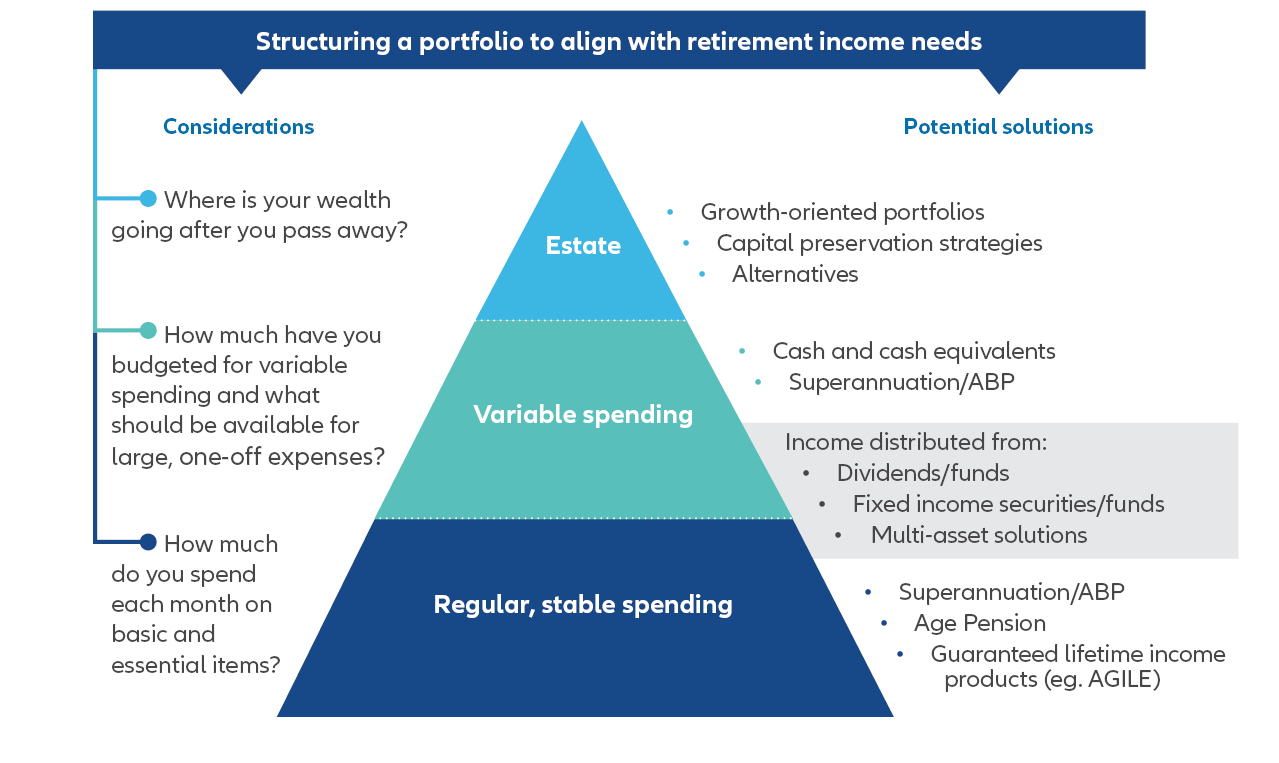
The base of the pyramid comprises expenditure on necessities, including housing, food, and healthcare. This essential spending has the greatest need for income certainty, and the least scope for flexibility. Securing this base is critical for retiree confidence.

The middle of the pyramid is where the discretionary dimensions of retirement spending are found, including those lifestyle items such as travel and leisure, and this is where the most opportunity for flexibility lies


The risks of fixed real retirement spending

Traditional approaches to retirement planning in Australia have typically centred on calculating an annual income level that is sustainable and can support a retiree’s desired lifestyle. Conventional wisdom dictates that – once calculated – this ‘magic number’ should be indexed each year for inflation.

The ubiquity of this approach can be seen in everything from conventional projection methods to retirement income product design, to the widely publicised ASFA Retirement Standard.

The rigidity of this approach is part of its appeal. It’s easy to model and retirees know with certainty what will go in their bank account each month.

But this predictability becomes a risk following a market fall. Consider a client withdrawing 4% from a $1.2m portfolio. That produces an annual withdrawal of $48,000 before CPI. But if the market falls and the portfolio value drops to $850,000, the effective withdrawal rate rises to 5.6%. 

The client is now removing a larger proportion of the remaining capital at a time when asset values are depressed. This means more assets may need to be sold, leaving less capital invested to participate in any subsequent market recovery. Continuing to increase the withdrawal amount in line with inflation adds further pressure.

Fixed real withdrawals can also constrain spending unnecessarily after sustained strong investment performance. A client may continue following a conservative spending path even though the portfolio could support a higher amount. This can contribute to the underspending seen among some retirees, who preserve more capital than they need while foregoing the lifestyle they could have afforded.

Dynamic spending methods

A dynamic approach allows the flexible – ‘mid-pyramid’ – component of spending to respond to weaker investment outcomes. But this is more than just ‘turning off CPI’ or telling your clients to forgo a holiday. Dynamic spending methodologies are rules-based, involving quantitative trigger points and adjustment limits to determine whether withdrawals should rise or fall.

Under Vanguard’s floor and ceiling approach1, for example, annual spending is calculated with reference to the portfolio’s previous year-end value. Increases are limited to 5% and reductions to 2.5%, helping to prevent abrupt changes in income.

Guardrail approaches adjust spending when an agreed measure moves outside set boundaries. Guyton and Klinger2 use changes in the portfolio withdrawal rate, while the probability-based method3 recalibrates spending annually to an amount that keeps the portfolio survival probability within upper and lower bounds.

There are other methods too, all differing in their calculations and the size of the permitted adjustments. 

Does dynamic spending deliver better outcomes?

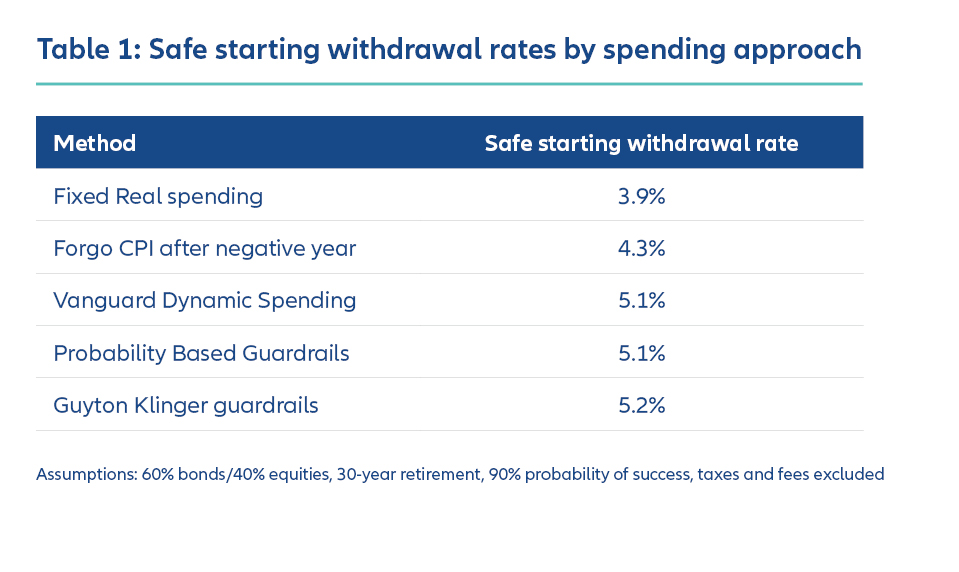
Morningstar compared several dynamic spending methodologies against a fixed real spending baseline4. It also tested the simpler step of forgoing an inflation adjustment after a negative return year.

Using 1,000 simulated return sequences, Morningstar calculated the starting withdrawal rate each method could support over 30 years with a 90% probability of retaining a positive portfolio balance (also referred to as ‘portfolio success’). A higher starting rate indicated that the method supported more initial spending at the same probability of success.

While forgoing an inflation increase after a negative year did improve the sustainable starting withdrawal rate, the more adaptive methodologies supported the highest ‘safe’ withdrawal rates.

The effect also extended to total spending over retirement. Morningstar found that probability-based guardrails produced approximately one-third (32%) more median lifetime withdrawals than the fixed real spending strategy under its modelled assumptions5. Vanguard’s historical modelling6 reached a similar conclusion, finding that its floor and ceiling approach produced higher cumulative spending than the traditional ‘4% rule’ across the periods tested. 

AGILE: Securing the base, so you can flex the middle 

Of course, the potential for higher lifetime spending is not without cost, that cost being far greater variability in income from year to year, which brings our spending pyramid back into focus. Just as all income is not the same, nor is all spending the same, and it is critical to align the characteristics of income with the nature of the spending being funded.

Essential spending – the base of the pyramid - is non-negotiable and is effectively a floor that must be secured. Paying for food, petrol, clothing, electricity and health care is something that should be stress-free and not dependent on a variable income source. This part of the pyramid demands predictable and dependable income to give retirees certainty. 

An allocation to Allianz Guaranteed Income for Life (AGILE) or AGILE Super+  can help support that dependable income layer, giving retirees the certainty and confidence that comes with having guaranteed income payments for life, however long that may be.

Crucially, securing the base can also create scope for a more dynamic approach to mid-pyramid expenses, which – as shown above – can support higher overall retirement spending while maintaining the same modelled probability of portfolio survival.

Practical takeaways for advisers

A dynamic spending strategy requires more than selecting a withdrawal methodology. Advisers should:

  • Separate essential expenditure from lifestyle spending that the client could adjust
  • Assess how much of the essential spending floor is supported by dependable income
  • Agree on a normal level of portfolio withdrawals and the upper and lower limits the client could accept
  • Document the triggers that would lead to an adjustment and how often the strategy will be reviewed
  • Identify the expenses that would change if withdrawals were reduced, so the flexibility is realistic rather than theoretical

Income layering determines where retirement income comes from. Dynamic spending determines how withdrawals from the flexible layer respond as circumstances change. Used together, they can create greater spending capacity and greater spending confidence in retirement.


References

1.        https://corporate.vanguard.com/content/dam/corp/research/pdf/vanguard_principles_retirement_income.pdf

2.        https://www.financialplanningassociation.org/sites/default/files/2021-11/2006%20-%20Guyton%20and%20Klinger%20-%20Decision%20Rules%20and%20SWR%20%281%29.PDF

3.        https://assets.contentstack.io/v3/assets/blt9415ea4cc4157833/bltb73b87c5d0c70ead/The_State_of_Retirement_Income_2025.pdf

4.        https://assets.contentstack.io/v3/assets/blt9415ea4cc4157833/bltb73b87c5d0c70ead/The_State_of_Retirement_Income_2025.pdf

5.        https://assets.contentstack.io/v3/assets/blt9415ea4cc4157833/bltb73b87c5d0c70ead/The_State_of_Retirement_Income_2025.pdf

6.        https://advisors.vanguard.com/content/dam/fas/pdfs/FAJAMEAG.pdf


This material is issued by Allianz Australia Life Insurance Limited, ABN 27 076 033 782, AFSL 296559 (Allianz Retire+). Allianz Retire+ is a registered business name of Allianz Australia Life Insurance Limited. This information is current as at September 2026 unless otherwise specified and is for general information purposes only. This information has been prepared specifically for authorised financial advisers in Australia and is not intended for retail investors. It does not take account of any person’s objectives, financial situation or needs. Before acting on anything contained in this material, you should consider the appropriateness of the information received, having regard to your objectives, financial situation and needs. The returns on Allianz Guaranteed Income for Life (AGILE) and AGILE Super+ are subject to a number of variables including investor elections, market performance and other external factors, and may differ from the information contained herein. Past performance is not a reliable indicator of future performance. No person should rely on the content of this material or act on the basis of anything stated in this material. Allianz Retire+ and its related entities, agents or employees do not accept any liability for any loss arising whether directly or indirectly from any use of this material. Use of the word ‘guarantee’ in this material refers to an assurance that certain conditions or contractual promises will be fulfilled by Allianz Retire+ from the available assets of its Statutory Fund No 2, in relation to the product terms. This includes ‘guaranteed’ income payments in the Lifetime Income Phase which will be paid from the available assets of Statutory Fund No 2, noting that Allianz Retire+ may terminate the product in certain limited circumstances as outlined in the Product Disclosure Statement referred below. Allianz Australia Life Insurance Limited is the issuer of AGILE and AGILE Super+. Prior to making an investment decision, investors should consider the relevant Product Disclosure Statement (PDS) and Target Market Determination (TMD) which are available on our website (www.allianzretireplus.com.au).


Any information on this website does not take into account your objectives, financial situation or needs. For personal financial advice please speak to your financial adviser. Products will be issued by Allianz Australia Life Insurance Limited, ABN 27 076 033 782, AFSL 296559.

Allianz Retire+ is the business name of Allianz Australia Life Insurance Limited. By using this website you agree to access this Financial Services Guide.